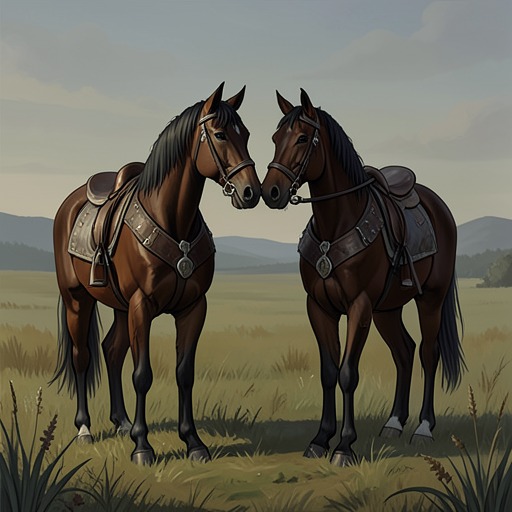
Black Beauty and Ginger as Friends
Black BeautyBlack Beauty and Ginger are both colleagues in harness and trusted friends whose relationship gives the horses’ experiences of kindness, injury, and separation a personal history. Their friendship begins at Birtwick Park, where they learn to work together and share their pasts; it endures through contrasting recoveries and decline, although human decisions repeatedly determine whether they can remain together.
Partnership at Birtwick Park
When Black Beauty first goes out in a carriage with Ginger, he is uncertain how the pair will manage. Ginger initially lays her ears back as he is brought to her, but she works honestly and pulls her share. On hills, she leans into the collar and draws the carriage steadily upward. Their courage and pace match, and John Manly more often has to hold them back than urge them on. He does not need to use the whip on either horse. Keeping step at a trot makes their work comfortable, and after two or three outings they become friendly and sociable. Their partnership is not merely a matter of matching strength: the horses’ shared willingness makes the work easier for them and pleasing to the people driving them.
The working team becomes a friendship beyond the carriage. In the orchard and paddock, Black Beauty and Ginger have time to stand together and talk, away from harness and instructions. Ginger asks about his upbringing and training, and Black Beauty’s account leads her to reflect that she might have developed a gentler temper had she been raised as he was. Their exchange reveals both closeness and difference: Black Beauty takes his early security as normal, while Ginger recognizes how profoundly treatment has shaped her. His initial belief that she may be overstating her past gives way to closer observation of her change at Birtwick.
Kindness and Ginger’s change
Ginger’s guardedness does not disappear simply because she has entered a better stable. She recalls having bitten James Howard, but also remembers that he approached her afterward with a bound arm, brought her a bran mash, and stroked her rather than retaliating. She says she has not snapped at him since and does not intend to do so while he and the other stable staff treat her well. This incident makes the friendship between the horses part of a wider pattern of trust being built through patient care: Ginger’s response is connected to specific, repeated acts of gentleness rather than an expectation that she should immediately behave as if nothing had happened.
Over the following weeks, Black Beauty sees her become gentler and more cheerful. James notices that she whinnies after him when he has rubbed her forehead, while John Manly jokes that The Birtwick horseballs will make her as good as Black Beauty. Squire Gordon also recognizes her improved spirits. When he strokes her neck and speaks to her, Ginger raises her nose toward him in a friendly, trusting gesture. The change strengthens Black Beauty’s understanding of her: what once looked like a fixed, defiant disposition proves responsive to safety and considerate handling. Their friendship gives him a close view of that recovery, while Ginger’s confidence in him makes their conversations a place where she can describe what her own experience has taught her.
Shared decline and renewed companionship
The horses’ fortunes later converge again in a small meadow. After Black Beauty’s knees have healed enough for him to be turned out for a month or two, he is alone and misses the company of horses, especially Ginger. One morning she is brought through the gate and left with him. They approach with joyful recognition, but the reunion is not a return to their former life together: Ginger has been turned out to see whether rest can help after hard riding has ruined her health.
Ginger explains that Lord George ignored a groom’s warning that she was strained and unfit for a steeplechase. He pushed her to keep pace with the foremost horses; she finished among the first three, but the effort further damaged her wind and strained her back. She and Black Beauty understand their decline through different causes: he had been ruined by a drunkard, while she had been ruined by a reckless rider. Their shared recognition of what has happened makes their companionship especially poignant, but the text does not make their injuries identical or suggest that friendship can undo them. They no longer gallop as they once did. Instead, they feed and lie together and spend long periods beneath a lime-tree with their heads close. They cannot restore their former strength, but they can still give each other company.
Separation and recognition
That renewed companionship is brief. After the horses are examined, Ginger foresees that Black Beauty will soon be taken away and fears losing the only friend she has. About a week later, Robert arrives with a halter and leads Black Beauty from the field. There is no opportunity for a proper farewell: the horses neigh to each other, and Ginger follows anxiously along the hedge, calling after him as long as she can hear his footsteps. Their separation is imposed by the human arrangements around them, not by any failure of affection or reconciliation between the two.
Much later, while Black Beauty waits with other cabs outside a park where music is playing, an old, shabby cab pulls up beside his. Its worn chestnut horse reaches for a small lock of hay that the wind has rolled toward her. She looks at Black Beauty and recognizes him. It is Ginger, now markedly changed by hard work: her former graceful neck has fallen, her legs and joints are altered, and her face and breathing show her suffering. The details make visible the cost of the years since their meadow reunion. Their brief recognition restores the intimacy of the earlier friendship, but offers no evidence that they can return to living or working together. At the end of Black Beauty’s story, he recalls the old friends of Birtwick in the orchard; the memory underscores how enduring that early community remains for him, even after Ginger and he have been parted.